

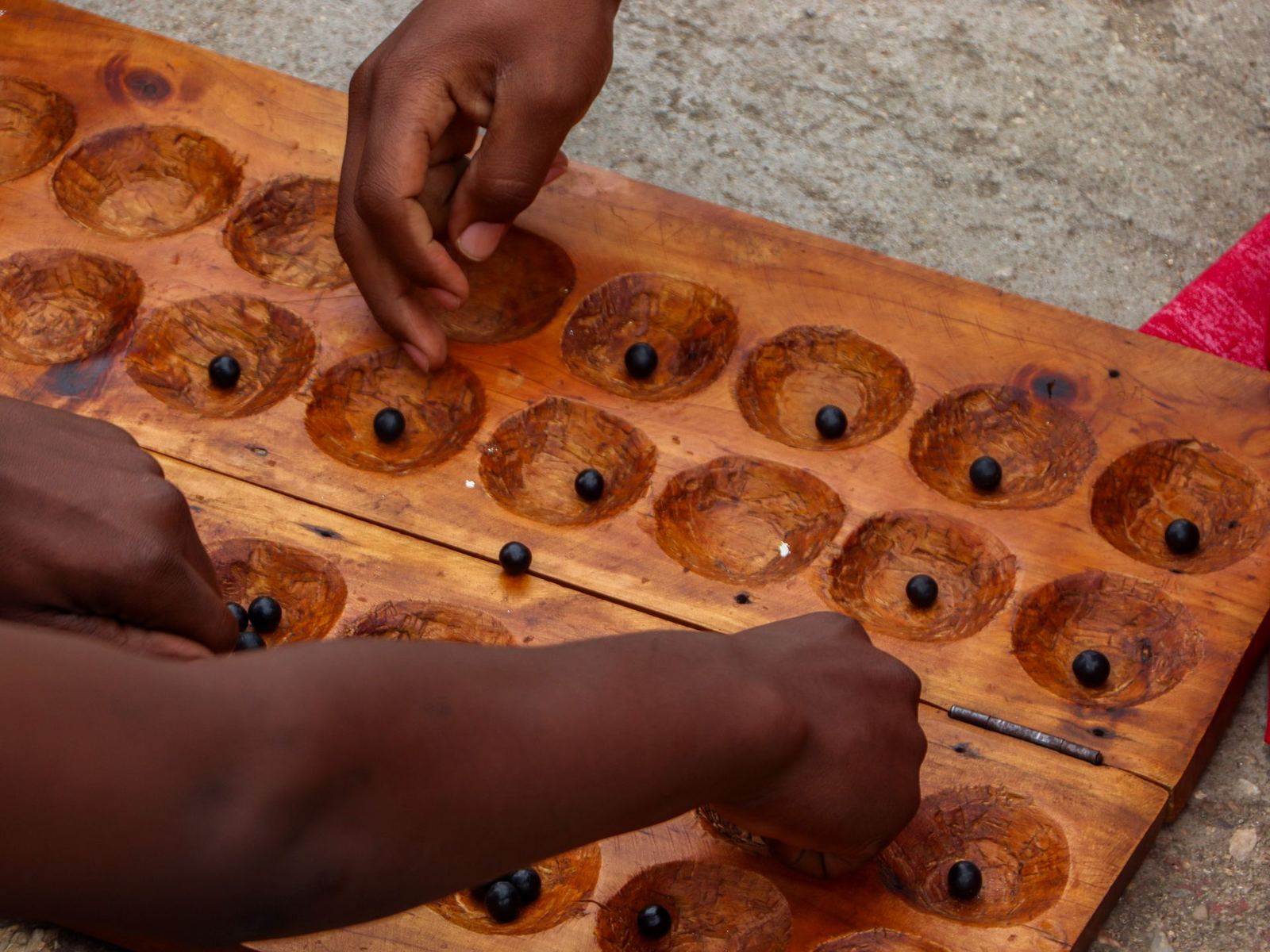
Two players, twelve pits, forty-eight stones: the basic rules of mangala, common strategies and tips for teaching it to children.
Mangala is Turkey’s member of the large family of “mancala” games played across Anatolia and Central Asia for centuries. Despite its simple equipment it is a deep strategy game, and in recent years it has become popular again through the Intelligence and Mind Games elective in middle schools. Here is a short guide to the rules of mangala, the favourite game of our mind games group. The rules below are the most common Turkish version; for competitions, check the organiser’s rules.
Equipment and set-up
Each player has six small pits in front of them and a large store on their right. At the start four stones are placed in each small pit, 48 stones in total. The aim is to have more stones in your store than your opponent at the end of the game.
Basic rules
- A player takes all the stones from one of their own pits and sows them one by one anticlockwise, starting by dropping one back into the pit they came from. While sowing, stones are dropped into your own store but not your opponent’s.
- If a pit holds a single stone, that stone is moved to the next pit.
- If the last stone lands in your own store, you take another turn.
- If the last stone lands in one of your opponent’s pits and makes the number there even, you capture all the stones in that pit and put them in your store.
- If the last stone lands in an empty pit on your own side and the opposite pit has stones, you capture both that stone and the stones opposite.
- The game ends when all the pits on one player’s side are empty; the stones left on the other side go to the store of the player who emptied their side first.
Strategy tips
Good mangala players think not only about their own move but also about their opponent’s reply. Moves that end in your store and earn an extra turn are a big advantage early in the game. Protecting pits with an odd number of stones that your opponent could make even, and setting up empty-pit traps on your own side, are the key ideas of the middle game. Towards the end, remember that emptying your side first can win you all your opponent’s remaining stones.
Teaching it to children
Because mangala naturally practises counting and simple addition, it can be taught from age 6 or 7. Playing at first with only the sowing rule and adding the even-number and empty-pit rules in later games makes learning easier. In our mind games group children discuss “which move changed the game?” together after every game.
Mangala and maths
Mangala is a game teachers often use in class, because every move involves counting, estimating and simple arithmetic. Working out in advance how far the stones from a pit will reach naturally develops children’s mental arithmetic. You don’t need a wooden board to play as a family: an egg carton and 48 small stones or buttons will do at home.